


Ultrazonic

Cleaning Hollow Instruments

Hollow instrument cleaning is one of the highest-risk steps in sterile processing because contamination can remain out of sight inside lumens and channels. When internal soils aren’t fully removed, they can undermine disinfection and sterilization, no matter how well the rest of the cycle is executed. At UltraZonic, we can support your medical environment with a repeatable, standardized approach that helps you protect patients.

Contact us to clean hollow instruments more effectively

US & EU Patent

Pioneer in automated pre-cleaning

Certified quality (CE, LGA and ISO 13485)

The Challenge of Cleaning Hollow Instruments

Hollow instruments introduce a specific risk profile because contamination can persist inside lumens, narrow channels, ports, and joints even when external surfaces appear clean. Hollow instruments are critical to clean. Internal residues are harder to access mechanically, harder to verify visually, and more sensitive to delays that allow soil to dry and fix to channel walls. Once residues mature, cleaning increasingly involves biofilm removal, which is particularly difficult in narrow pathways where mechanical access is limited. Inconsistent flushing, incomplete brushing, or inadequate drying can carry residual soil into downstream disinfection or sterilization steps, undermining process repeatability.

MED: Ultrasonic Cleaning Support

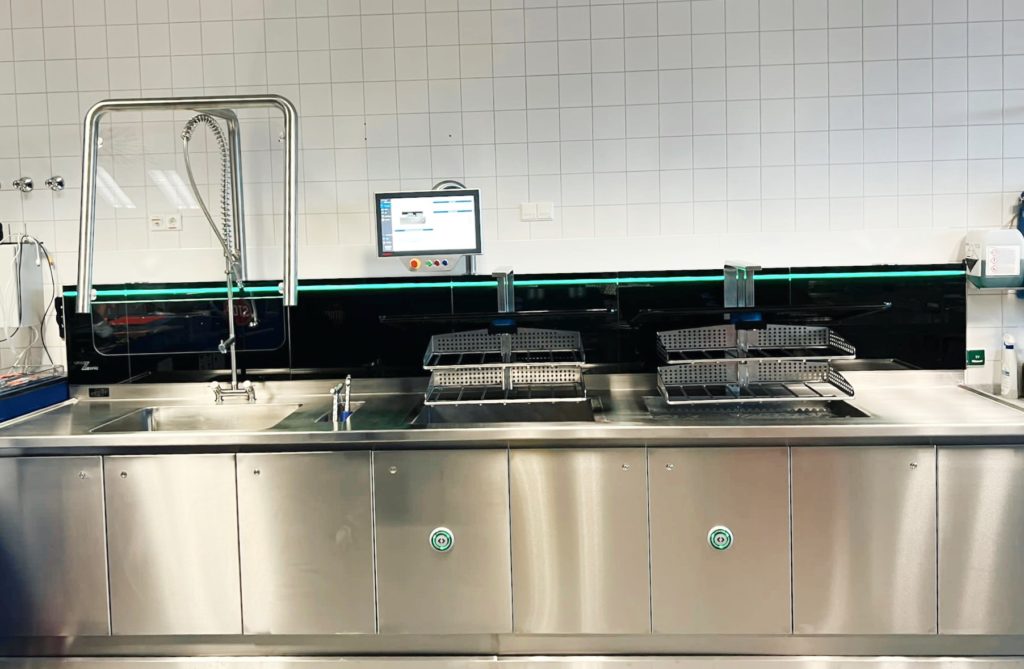
Ultrasonic waves are commonly used to clean hollow instruments because they can reach the smallest cavities where manual action has limited reach. We have developed MED: an ultrasonic cleaner for surgical instruments. The device delivers fast, repeatable pre-treatment for surgical instruments while reducing operator dependency when dealing with complex instrument geometries. Advanced frequency modulation can also be applied to support more stable cleaning action across varying loads and geometries.
MED Luxemburg

Talk to us about hollow instrument cleaning

UltraZonic Pioneerism

Step-By-Step Workflow

A repeatable workflow to clean hollow instruments reduces variation between operators and helps ensure internal channels are treated consistently.

  1. Point-of-use control: prevent soil from drying and keep channels open during transport to decontamination.
  2. Pre-cleaning & lumen preparation: initiate flushing and perform any required brushing so channels are accessible to cleaning solution.
  3. Ultrasonic cleaning: run a controlled ultrasonic cycle with appropriate chemistry, time, temperature, and load configuration to support internal soil removal.
  4. Rinsing: rinse thoroughly to remove detergents and loosened residues from internal channels.
  5. Drying: dry lumens and internal pathways to prevent retained moisture before downstream processing.
  6. Inspection & documentation: confirm completion of steps and route any exceptions for re-cleaning before disinfection/sterilization.

Reach Out to Discuss Your Environment’s Lumen Cleaning Consistency

We help you clean hollow instruments by stabilizing ultrasonic pre-treatment and reducing workflow variation in complex lumen processing. In our academy, your sterile processing teams can learn how structured cleaning steps and documentation help protect patient safety in daily reprocessing practice. Contact us to discuss how we can support reprocessing in your clinical environment.

let's talk!

We are here to listen and help where possible.